

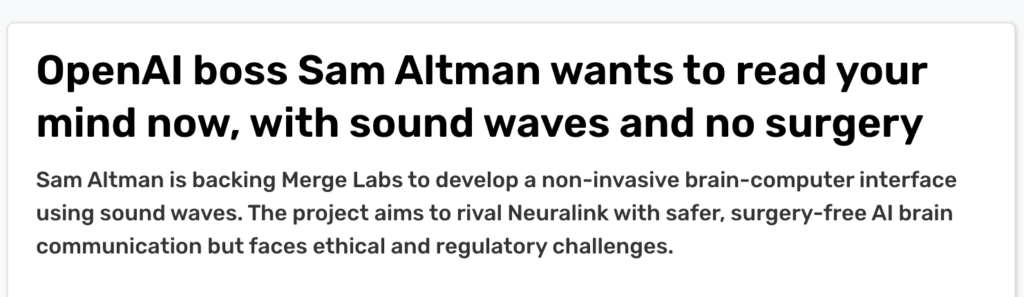
Over the past two to three years, OpenAI—the company that has sparked a global AI revolution with ChatGPT—has been heavily backing Merge Labs, a startup developing a completely different type of Brain-Computer Interface (BCI). This news has been circulating throughout the AI field for the past two to three months. Merge Labs’ BCI technology is drawing significant attention as a completely new approach. It reads signals within the brain using ultrasound, without requiring drilling holes in the skull to insert chips or implanting devices into blood vessels. The mechanism appears to combine two technologies: Genetic Neuron Modification (genetic modification of certain brain neurons) and an ultrasonic transducer. It modifies some brain neurons to respond to ultrasound, then sends ultrasound through a wearable headband and converts the returning signals into messages. It’s still in the very early stages of development; there’s no website yet, and details haven’t been announced, so I’ll continue to follow the news.
Currently, Merge Labs is valued at $850 million (approximately ¥85 billion, or ¥132.14 billion), and has reportedly received a $250 million ($250 million, approximately ¥31.86 billion) investment from OpenAI. The co-founders are Sam Altman of OpenAI, Alex Blania of Tools for Humanity (a company developing iris-scanning devices for identity verification), and Mikhail Shapiro, Professor of Molecular Engineering at Caltech (California Institute of Technology). Professor Shapiro is a renowned scientist who developed ultrasound-based brain interaction technology and is a key figure in Merge Labs’ BCI technology.
Merge Labs’ BCI positions itself as a competitor to Elon Musk’s Neuralink BCI, which this column has covered several times since last year. It emphasizes its strengths: no need to drill holes in the skull, no need to insert multiple tiny needles into brain tissue—meaning no risky surgery—making it a technology potentially more accessible to the general public. It also competes with Synchron Inc.’s stentoid BCI, which we’ve also introduced several times in this column. Synchron’s approach involves inserting a tiny device, like a stent, into the blood vessels surrounding the head to receive brain signals. While Neuralink and Synchron have already begun human trials, Merge Labs likely still has some time before reaching that stage. We’ll keep you updated if any developments emerge.
https://www.precedenceresearch.com/news/altman-brain-computer-interface
https://futurism.com/health-medicine/sam-altman-startup-read-brain
Reported by Nobuko Schlough@P-ALS on Nov. 18, 2025